Cheaper Claude Sonnet 5.5 just beat pricier Opus 5.5
Claude Sonnet 5.5 costs less than Opus 5.5 and beat it on a real automation benchmark, and it's already live everywhere you'd use it.
Four-minute read. Today: the cheaper Claude model just beat the pricier one on real work, and it’s live everywhere already.
PRICING
The cheaper Claude model just outscored the expensive one
What changed. Anthropic released Claude Sonnet 5.5, priced at $2/$10 per million tokens with a 1 million token context window, less than a week after its pricier Opus 5.5; on a new real-world automation benchmark, Sonnet 5.5 scored 44.7% against Opus 5.5’s 40%, at a lower cost per task run.
What it means at your size. If any automation you run, customer email replies, data entry, lead follow-up, lets you choose which AI model powers it, you may be paying for the pricier model when the cheaper one now does the job as well, or better, for less.
The first step. This week, open the model or AI settings in whichever automation platform you use and check which Claude version each workflow is set to; if it’s pinned to Opus, that’s now worth reconsidering.
The limitation. This is one benchmark from a single automation-testing suite on generic tasks, not a test of your specific workflows, and it was run by the company that also sells the automations being benchmarked.
Anthropic on the Claude Sonnet 5.5 launch (anthropic.com)
The rest of the day
📧 Perplexity now offers to summarize your email inbox into a short digest, useful if unread messages are the first thing eating your morning. (news.google.com)
🔜 OpenAI teased tomorrow’s DevDay keynote with a bare “Get ready” and no details yet; if you’re about to lock in a ChatGPT plan or pick a model for a new workflow, the extra day of waiting may be worth it. (x.com)
🎬 Google named the winning entry in its Future Vision XPRIZE, “The Gifted,” a short film made entirely with AI tools, a sign AI video has reached the point of winning a judged contest, not just filling a feed. (blog.google)
💰 One creator handed OpenAI’s Codex and GPT-6 Astra a real $10,000 to trade stocks on its own for a week, a live test worth watching before you give any AI tool access to your own accounts. (youtube.com)
Built with AI
Alex Prompter, who went to film school, had Opus 5.5 build a 30-second animated explainer for a business from one prompt: five scenes covering the customer’s problem, what the business does, how it works in three steps, one proof point, and the name at the end. Claude plays it in the chat and you screen-record it. You could make one for your own business this afternoon, for your website, a pitch deck or socials. His prompt is public, so copy it, fill in what you sell, who it’s for and your colours, then give notes one at a time, like “slower” or “add a scene about pricing.” (x.com)
The Open Source Toolshed
Moritz Kremb’s launch-video prompt is a free, publicly posted prompt that has Claude make a motion-graphics product launch video, the kind software companies post when they ship, showing off features and benefits with real images pulled from the web. It’s for any owner with a product, app or service to announce and no video editor. As written, it asks Claude to pick a well-known software product as the example, so swap that line for your own product and its website, then paste it into Claude and go. Nothing to install. (x.com)
The AI Odometer
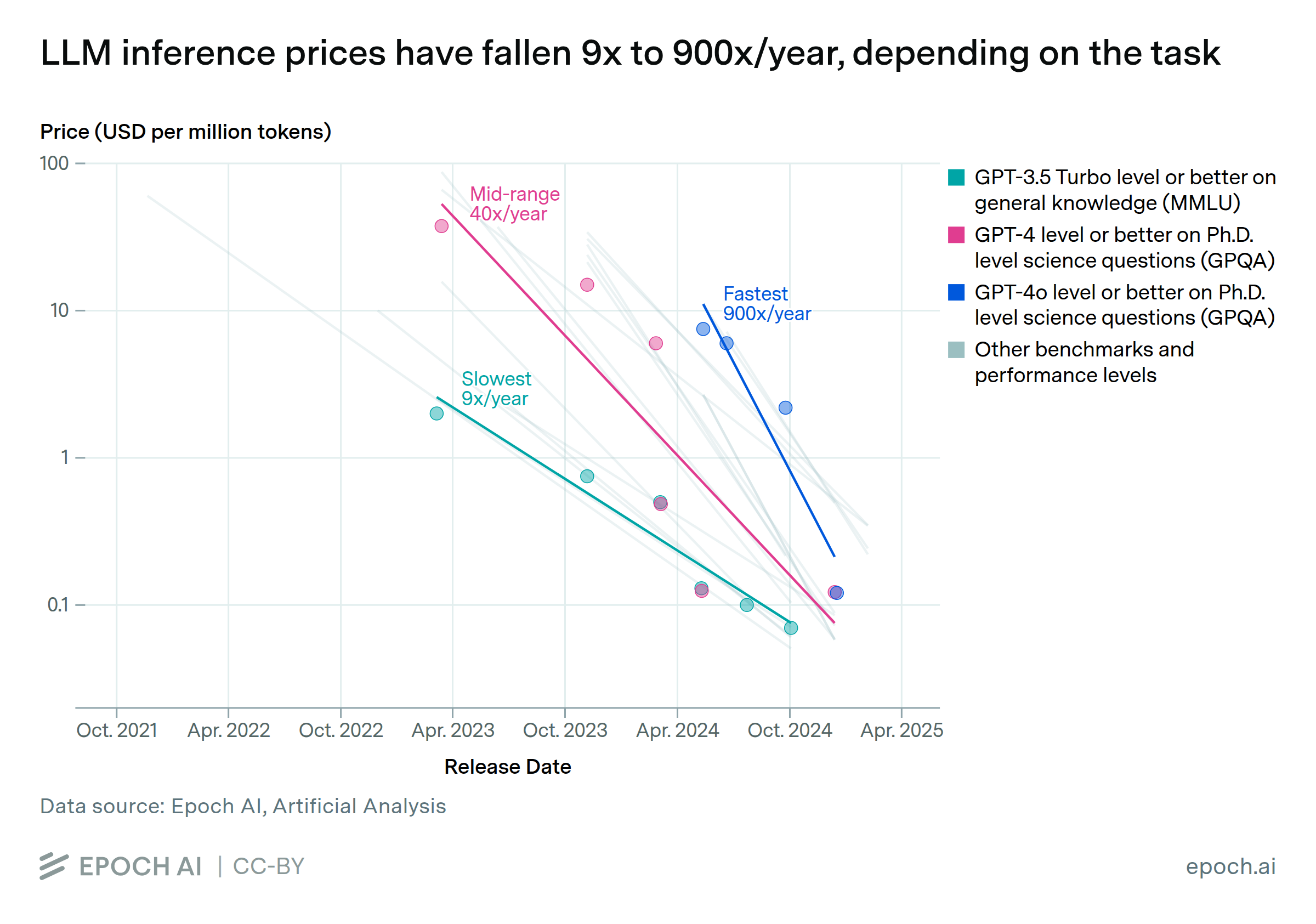
Source: Epoch AI, “LLM inference prices have fallen rapidly but unequally across tasks” (12 March 2025). Chart by Epoch AI, used under CC BY 4.0.
“The price to achieve GPT-4’s performance on a set of PhD-level science questions fell by 40x per year.”
The same quality of AI help that looked too pricey for a small team in 2023 now costs a small fraction of that, and the price is still falling. If you ruled a task out on cost a year or two ago, it is worth pricing again.
Too early
Greg Isenberg is pitching a “$5T AI roll-up” wave: buy up small, ordinary businesses such as accounting firms or property managers, then run the back office with a lean team and AI agents instead of the old headcount. The idea has real logic to it, but it assumes capital to buy a business outright, a structure for approving what the agents do, and trust in software you didn’t build; worth knowing the shape of it now, not acting on it yet. (youtube.com)
🎬 One for the road
Gavin Purcell gave his AI agent, Fig (running on Opus 5.5), a set of video tools and got back a 27-minute documentary about AI, in five parts, with a sources list. The host, Dr Imogen Ashby, walks London in a camel coat talking data centres, chip fabs and jobs, then the last shot pulls back to show her cosy pub is a set on an empty soundstage. She signs off: “I’m Imogen Ashby. Well, I’m not, but you knew that.” Every frame, word and note of music was generated. Fig gets “written and directed by”. Gavin, who says he only gave notes like a producer, gets “produced for”. Welcome to management. (x.com)