🌐 Apps you build in Gemini can now become Google Sites pages
Apps you build in Gemini can now become Google Sites pages, no developer needed.
Four-minute read. In today’s issue: apps you build in Gemini becoming Google Sites pages, Notion AI switching to monthly credits, Airtable automations that fire on a status change, Gemini in Sheets on the iPhone, and a wizard chess set built by AI.
PUBLISHING
Apps you build in Gemini can now become Google Sites pages
What changed. Google Workspace Updates said on 19 October that interactive apps built in the Gemini app can now be exported to Google Sites. Each export makes a private site draft you edit and then publish, on web, Android and iOS, for Workspace and personal Google accounts.
What it means for you. A price calculator, booking form or quote tool your team sketches in Gemini can become a page you share with customers, without hiring anyone to build it.
The first step. Build one small app in the Gemini app this week, such as a delivery-cost calculator, export it to Sites and test the draft yourself before you publish it.
The limitation. Export works only where Google Sites is turned on for you and you are allowed to create sites, and each page follows your organisation’s existing Sites and Drive rules. Google lists no other limits, so test the page on a phone before you share it.
Google Workspace Updates on publishing Gemini apps to Google Sites (workspaceupdates.googleblog.com)
BILLING
Notion AI moves to monthly credits that pause when they run out
Notion moved new Business and Enterprise workspaces to a new AI credit system on 19 October, and existing workspaces switch on 2 November. Each member gets 1,500 Standard and 500 Select credits a month, and unused credits do not roll over.
When credits run out, those AI features pause until the monthly reset unless an admin lets the team draw on Notion credits. In Notion’s own testing, Auto, which picks the model for you, cost 87% less on average than Opus 5.5.
Before 2 November, open Settings, Notion AI, Usage to see how fast your team spends credits, and set Notion Agent to Auto for everyday writing.
Notion’s help page on managing AI credits (notion.com)
Just shipped
Airtable shipped 15 updates to automations, interfaces and navigation this week, community manager Kyle Masterson wrote on 19 October. Automations can now fire when a field moves from one chosen value to another, so the manual “previous value” workaround can go.
Kanban views can also show a total for each stack, not only a card count. Rebuild one status-change automation on the new trigger this week. (community.airtable.com)
Affiliate link: we may earn a commission if you sign up, at no cost to you.
The rest of the day
📱 Gemini in Google Sheets now works in the iPhone and iPad app, rolling out from 15 October on Business, Enterprise and Google AI Plus, Pro and Ultra plans. Tap the Gemini spark icon in a sheet you already track and ask for a summary or a chart. (workspaceupdates.googleblog.com)
🪞 Canva added a Mirror Effect that adds a glossy, glass-like reflection to a design without moving, removing or rewriting any existing text or elements, Canva said on 19 October. Try it on a product shot or a cover image before reaching for a photo editor. (x.com)
🎞️ Gemini Notebook now shows you the outline for slides, or the plan for a video overview, before it builds them, rolling out to all users this week. Turn on the review toggle next time you turn notes into a client presentation. (blog.google)
🗒️ Google Chat now posts a recap after a Meet call that used “Take notes for me”: a summary, decisions and action items with owners. It is on by default for Business Standard and above, reaching all accounts from 27 October. Read it instead of replaying the recording. (workspaceupdates.googleblog.com)
🛠️ Built with AI
Sydney Bordonaro, a stylist for professional athletes, uploads photos of the clothes she sources and has Gemini show the full look on her client, then sends that picture for approval before anything ships. A florist, decorator or tailor could show a client the finished result the same way before buying stock. (blog.google)
🧰 The Open Source Toolshed
What it is. Handy is a free, open-source speech-to-text tool: press a key, talk, and the text lands wherever your cursor is, processed entirely on your own machine.
Who it’s for. A small team that drafts emails, notes or client updates by voice, especially anyone who wants nothing sent to a cloud service to transcribe it.
How hard it is. Install the app for Mac, Windows or Linux and set a hotkey; no terminal and no account.
MIT licence. (github.com)
📈 The AI Odometer
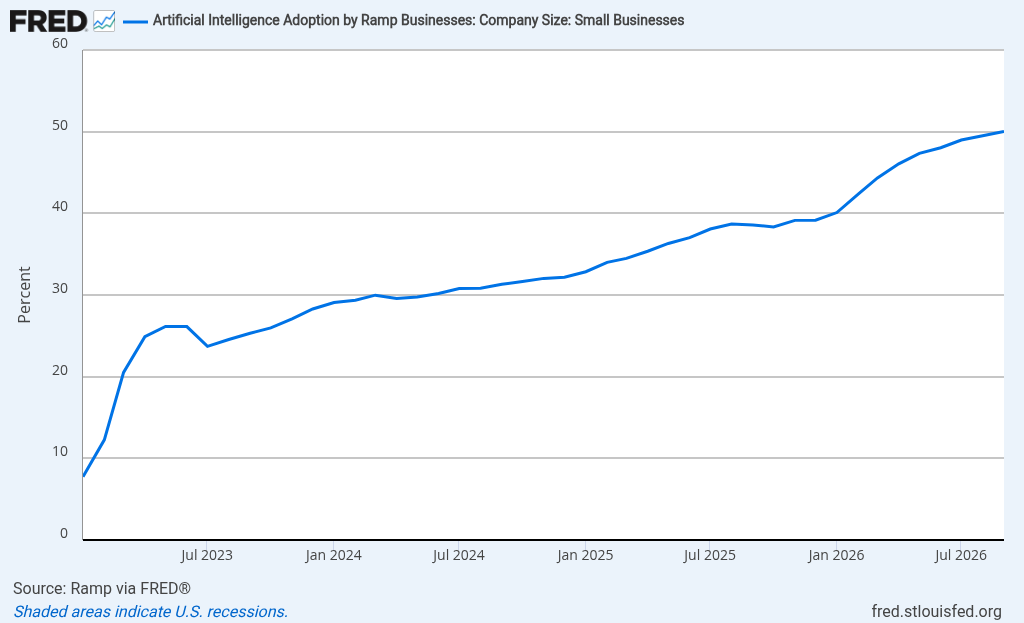
Source: Ramp AI Index via FRED, “Artificial Intelligence Adoption by Ramp Businesses: Small Businesses”, updated 14 October 2026. Data © Ramp, from card and bill-pay spend at more than 70,000 US businesses.
Sep 2026: 50.03241 percent
What it means for you. Half of small businesses on Ramp now pay for an AI tool, up about two points since June. Before adding another tool, list what your team already pays for and cancel any seat nobody opened last month.
Too early
Notion teased an “AI Command Center” alongside this week’s AI upgrades, Notion said on 19 October, with no date for when it arrives. Until it ships, there is nothing to check or switch on. (x.com)
🎮 One for the road
Google’s Gemini team built a playable 3D Wizard Chess game from scratch with Gemini 4 Argon in the Gemini app for Mac, Gemini App said on 19 October.
A team of AI agents modelled the pieces, designed the board and animated every move. No wizards were consulted. (x.com)