🌍 Google Meet now translates 63 languages, guests included
Google Meet now translates speech between 63 languages, and outside guests get it too.
Four-minute read. In today’s issue: Google Meet translating calls across 63 languages, Canva’s new image model that gets the text right, box and whisker charts in Sheets, a reel factory from Higgsfield, and robot ducks napping on cue.
MEETINGS
Google Meet now translates speech between 63 languages, and your guests get it too
What changed. Google Workspace Updates said on 22 October that speech translation in Google Meet now covers 63 languages on web, Android and iOS. Meet detects which language each person is speaking and translates it into each listener’s own, even when someone switches mid-call.
What it means for you. A call with a supplier, contractor or client who is more at home in another language no longer needs an interpreter. Guests from outside your company get translation too, as long as the organiser has an eligible plan.
The first step. Book your next call with a contact who speaks another language from an eligible account, turn on translation from the meeting toolbar, and ask them afterwards how well it carried.
The limitation. It needs Business Standard or Plus, Enterprise Standard or Plus, or Google AI Pro or Ultra, and runs up to 90 minutes a meeting on base plans. It does not work on recordings, dial-in calls or live streams, and Google says regional and age restrictions apply.
DESIGN
Canva’s new image model plans the layout before it draws
Canva launched Craft on 22 October, its first image model built for design, available to everyone in Dream Lab. Canva says it plans the composition before rendering, for more precise layouts and accurate text inside the image.
Canva also says Craft ranks second on Design Arena’s image leaderboard, in its own figures. Try it this week on a sale banner with words on it, and check every word before it goes out.
Canva on introducing Craft (canva.com)
Just shipped
Google Sheets now builds box and whisker charts straight from a range of raw numbers, working out the median, quartiles and outliers with no helper formulas, Google said on 22 October. Excel files with these charts now keep them on import, and they export back to Excel as editable charts.
It is rolling out from 22 October with no admin setting to change. Plot a month of order values or delivery times to see which ones are unusual. (workspaceupdates.googleblog.com)
The rest of the day
📲 Claude Duet, Anthropic’s new agent app, sends a morning brief from your connected apps and checks with you before it acts. Anthropic built it for “professionals and small business owners”, and it is a waitlist for US Pro and Max subscribers. (claude.com)
🧩 Anthropic gave Agent Skills, its format for saved instructions an AI follows, to the Agentic AI Foundation, which already holds MCP. Anthropic says more than 70 platforms, ChatGPT among them, already read the format, so a skill your team writes once is not locked to Claude. (anthropic.com)
🎬 Higgsfield launched Content Factory, which turns an idea into a short reel, from “what if” explainers to animated hooks for ads, available now. Make one reel for next week’s offer before you brief an editor. (x.com)
Affiliate link: we may earn a commission if you sign up, at no cost to you.
🔑 Vercel surveyed more than 1,000 software vendors and found only 8.4% support secure sign-in methods for app-to-app connections, CTO Malte Ubl wrote on 22 October. List the API keys pasted into your tools this week and delete the ones nobody uses. (vercel.com)
🤖 From next week, Claude sessions on web, desktop and mobile run in auto mode by default on Pro, Max and Team plans, Claude said on 22 October. An automated check blocks risky actions instead of asking you to approve every step, and you can switch back to manual any time. (x.com)
🛠️ Built with AI
Ethan Mollick’s AI assistant, his Dot, spotted Google security notices in his email and asked whether he had removed his app passwords on purpose. Ask the assistant connected to your email to flag security alerts the same way. (x.com)
🧰 The Open Source Toolshed
What it is. Buzz is a free app that transcribes and translates audio and video files on your own computer, so nothing you record gets uploaded anywhere.
Who it’s for. Any small team that records calls, interviews or meetings and wants a written record without sending recordings to a cloud service.
How hard it is. Install the app for Mac, Windows or Linux and drag in a file; no account and no terminal.
MIT licence. (github.com)
📈 The AI Odometer
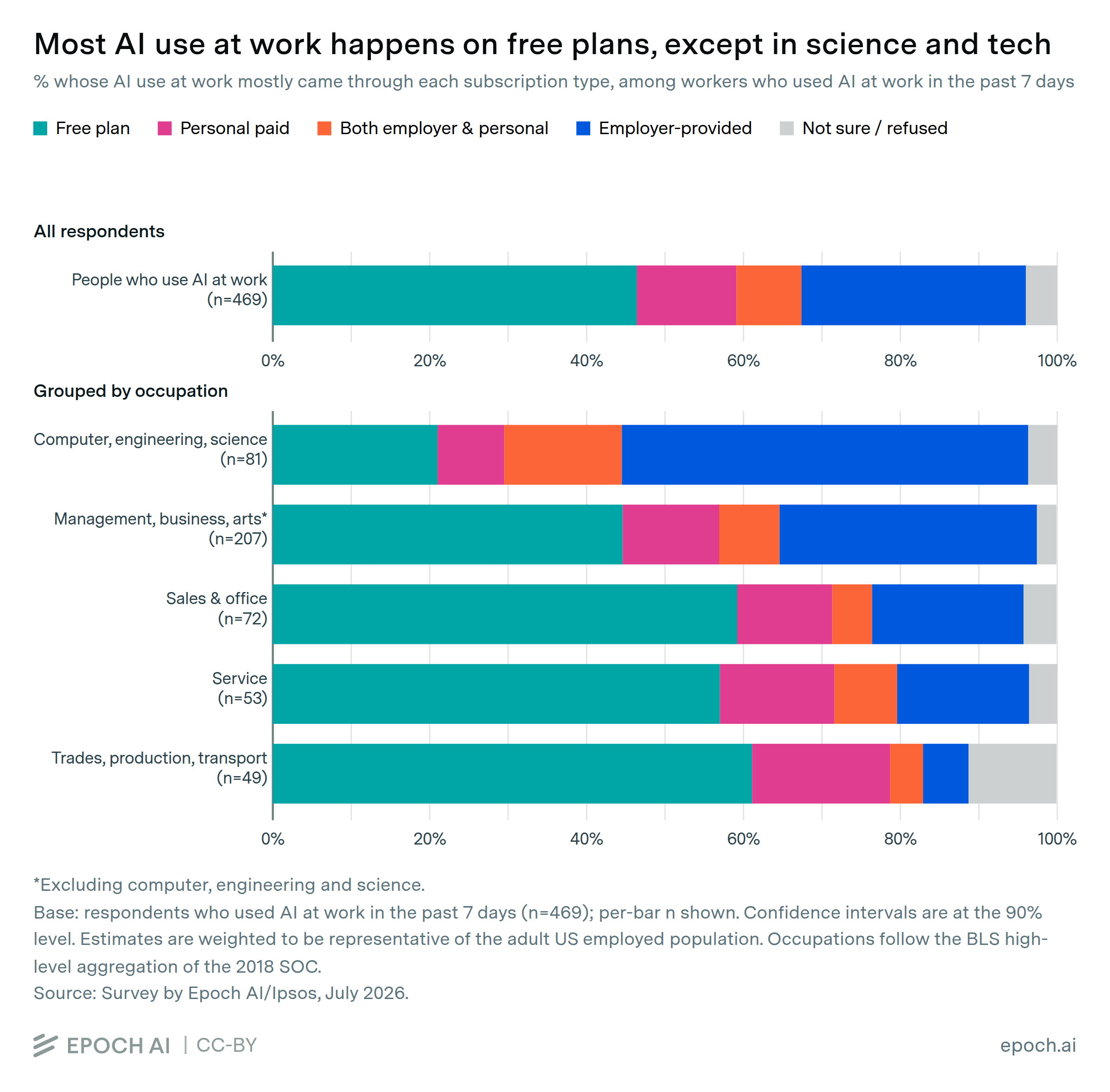
Source: Epoch AI, “Most AI use at work happens on free plans, except in science and tech”, 14 August 2026, Amreeta Das and Caroline Falkman Olsson, survey by Epoch AI/Ipsos, July 2026. CC BY 4.0.
For most occupation groups, free plans are the most common way to access AI at work (45% to 61% of workers).
What it means for you. Your staff are probably already using AI at work on their own free accounts, outside anything you set up. Ask the team this week which AI tools they use for work, and on whose account.
Too early
Make announced MakeOS at its Waves ‘26 event: one place where AI agents do a company’s work, with every action visible, permissioned and reversible. It is a waitlist with no date, so there is nothing to switch on yet. (community.make.com)
Affiliate link: we may earn a commission if you sign up, at no cost to you.
🦆 One for the road
Jensen Huang closed Nvidia’s GTC Berlin keynote with ducks. He said the way to build an agent is to ask an agent to build it for you, so he set one up with a single prompt.
The agent, Nous Research’s Hermes, planned an obstacle course and trained thousands of simulated ducks on it. Then four real robot Microducks joined him onstage, sitting down, standing up and taking a nap on cue.
Somewhere, a thousand virtual ducks fell over so four real ones could nap. (youtube.com)