🔏 ChatGPT text is getting an invisible AI label
OpenAI is extending content provenance to the text ChatGPT writes, to meet new EU rules.
Four-minute read. In today’s issue: an invisible AI label coming to ChatGPT’s text, a 15-second pitch video made by prompting, the $200 Claude-versus-ChatGPT question, and a lab whose AI-agent bill doubles every month.
PROVENANCE
Text you write with ChatGPT will soon carry a hidden “made by AI” marker
What changed. OpenAI said on 5 October it is expanding its content provenance approach to text, to meet new EU rules that require AI output to be machine-readable as AI-made. It already marks images and audio. Claude has marked text since August.
What it means at your size. If you paste AI-written copy into client reports, proposals or web pages, detection tools may be able to tell. That matters most where a client or platform expects human-written work.
The first step. List the three places your business publishes AI-drafted text this week. For each, decide whether you would be comfortable if the reader knew. Where the answer is no, rewrite it in your own words or say plainly that AI helped.
The limitation. OpenAI itself warns that text marking has technical limits, and it has not said exactly when or where the marker switches on. Heavy editing may remove it.
OpenAI on EU text provenance rules (openai.com)
Just shipped
ChatGPT Ads now report back to the tools you already track sales in. On 5 October OpenAI connected ChatGPT Ads to attribution tools including Triple Whale, AppsFlyer and Northbeam, so a sale that starts in a ChatGPT ad shows up in the dashboard you already check.
Any business can sign up at ads.openai.com today; a new image-based ad format starts testing later this month in the US with a small group of advertisers. If you sell on Shopify and use Triple Whale, you can now compare what a ChatGPT ad costs per customer against your Google or Meta ads before you move any budget. (openai.com)
The rest of the day
💬 Which $200 plan gives more? Claude was the most-discussed AI topic of the day, from 11 separate sources. Min Choi argues Claude now gives more for the same $200 a month than ChatGPT. Before you renew either top plan, count how often you actually hit its limits. (x.com)
🧾 Xero tops a customer-satisfaction ranking in New Zealand. Canstar named it the small-business accounting software customers are most satisfied with in 2026. If you are choosing books software in NZ, it is one more data point. (blog.xero.com)
🔓 A cheaper open model from the US. Reflection AI released Beam, an open model that Artificial Analysis rates among the most token-efficient for its level. Efficient open models tend to push the price of AI tools down for everyone. (marketwatch.com)
📊 Are AI usage numbers telling the full story? Ethan Mollick points out that most reporting on AI use looks at the same handful of labs. Treat any single “everyone is using X” chart with care. (x.com)
📈 Stock charts in Google Sheets. High-low-close and OHLC charts, rolling out from 5 October. Mostly for people who track markets. (workspaceupdates.googleblog.com)
🛠️ Built with AI
A small Amazon wholesale seller made a 15-second pitch video to send to brands, just by describing it to Claude. If you sell to other businesses, the same move gives you a short intro video for cold outreach without hiring an editor. (x.com)
🧰 The Open Source Toolshed
What it is. Anthropic’s public skills library: ready-made instruction packs that teach Claude a repeatable job, such as building a branded document or a spreadsheet.
Who it’s for. Anyone at a small business who keeps typing the same long instructions into Claude.
How hard it is. Download a skill folder and upload it in Claude’s settings; no code needed.
Apache-2.0 licence. (github.com)
📈 The AI Odometer
Source: Social Capital, “What AI spend does to headcount”, 2 October 2026.
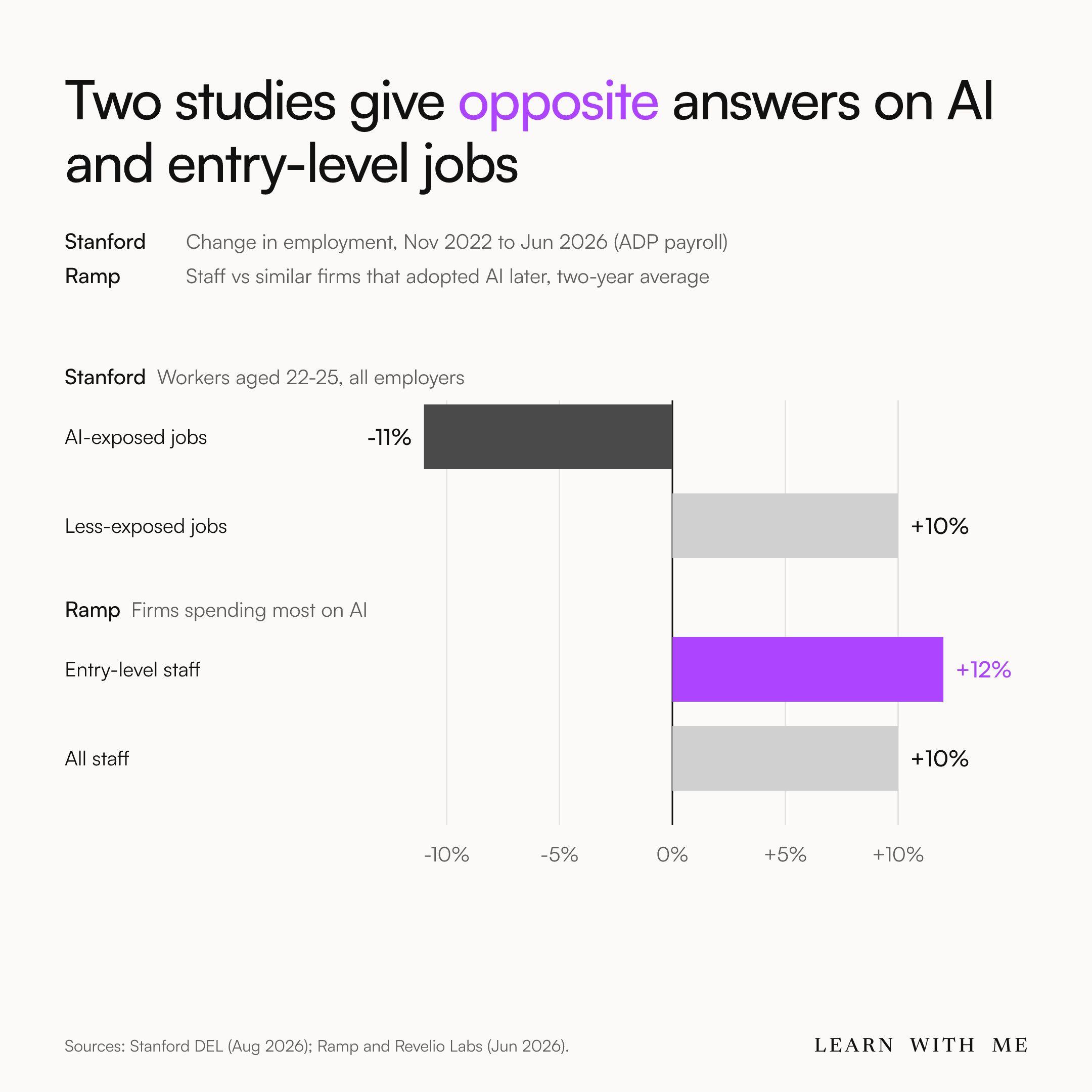
12%. Firms that spent the most on AI per employee averaged 12% more entry-level staff over the two years after they started paying for it, compared with similar firms that adopted later. That is Ramp’s card-spend data, as reported by Social Capital.
A Stanford study of payroll records points the other way: employment of 22-to-25-year-olds in the most AI-exposed jobs fell 11% since late 2022. Both can be true. The heavy adopters grew, and they hired juniors to grow.
What it means for you. Buying AI did not shrink these teams. Before you cut a junior role, check whether AI could let that person take on more work instead.
Too early
Reka AI says its new Rho-1 model collapses text, image and audio into one system instead of several stitched together. No public pricing or product yet, so file it under “watch”. (news.google.com)
🧠 One for the road
@trikcode asked Claude to show the inside of its own mind. Claude built the answer itself: a short animated video, made by Opus 5.5.
Over 268,000 people have watched it, and about 5,000 liked it.
It is not a real picture of how the model thinks. Nobody has one of those. It is Claude’s own artistic take, and that is what makes it fun.
Two more in the same vein:
- @RoundtableSpace: “what Opus 5.5 actually sees when it thinks.”
- @jtevesobs asked it what fear feels like for an AI. The answer is pure chaos.
Takeaway. One prompt now gets you a finished, shareable animation. If you have ever wanted a short explainer clip for your shop or service, ask for one and see what comes back.