AI shopping agents are sending buyers straight to brands
Shopify's CEO says he keeps hearing it: people shopping through Meta's Muse agent are buying from brands directly.
Four-minute read. In today’s issue: AI shopping agents sending buyers to brands, a calendar prompt that finds work to hand to AI, safer Shopify discount tests, the small-business AI gap, and a weekend of AI music videos.
COMMERCE
AI shopping agents are sending buyers straight to brands
What changed. Shopify CEO Tobi Lütke shared a customer’s post on 4 October saying they now buy from brands directly through Meta’s Muse agent instead of going to Amazon. “Hearing so many of these stories,” he wrote.
What it means at your size. If shoppers ask an AI agent to find and buy things for them, the agent picks from what it can read. A small brand with clear product pages, prices and stock can win a sale it would have lost to a marketplace.
The first step. Ask ChatGPT, Gemini or Muse to find a product you sell, the way a customer would. If your store doesn’t come up, or comes up with the wrong price or details, fix that product page first.
The limitation. This is one founder’s observation, not a measured shift. Muse for Small Business is only live in the US and Canada so far.
Meta on Muse for Small Business (about.fb.com)
WORKFLOWS
Find the hours you can hand to AI, straight from your calendar
What changed. Zephyr, who writes about AI systems for solo operators, shared a prompt on 4 October that reads your last 14 days of calendar and email and sorts every task into hand off, keep or drop.
What it means at your size. The hard part of using AI at work isn’t the tool, it’s knowing which jobs to give it. Your own calendar already holds the answer.
The first step. Connect your calendar and email to Claude or ChatGPT, then ask: “Look at my last 14 days. List every repeat task and sort each into hand off to AI, keep, or drop.” Start with the top item on the hand-off list.
The limitation. Only connect accounts you’re comfortable letting an AI read, and check its first few hand-offs before letting them run unattended.
How to connect Google Workspace to Claude (support.claude.com)
Just shipped
Test a discount before you give it to everyone. Shopify now lets store owners add discounts to Rollouts, its tool for showing a change to part of your traffic first, according to its 2 October changelog.
You can show a new offer to some visitors, compare sales against your current offer, then roll it out or pull it.
If you run a Shopify store, try your next promotion on a slice of traffic before it touches your whole margin. (changelog.shopify.com)
The rest of the day
🎨 Redesign your store by asking. Shopify’s new Canvas lets you see every page of your store at once and tell its Sidekick assistant what to change, from one section to a full redesign, rolling out to existing stores from 1 October. (changelog.shopify.com)
🛒 Your products may already be in Meta’s AI. Shopify now shares store products with Meta by default as an AI sales channel. If you sell on Shopify, check your agentic storefront settings to see what’s shared and how it’s performing. (changelog.shopify.com)
📱 Is the app era ending? The AI Daily Brief asks what replaces apps once people get things done by asking an agent instead of opening software. Worth a listen before you commission your next app. (youtube.com)
🛍️ ChatGPT as a sales channel. Pietro Schirano says ChatGPT now sends his product so much traffic that he added an “Open in ChatGPT” button to its landing page. (x.com)
🛠️ Built with AI
A popular r/ClaudeAI post this weekend describes someone with no app background building small apps for their own use with Claude, and finding it “kinda scary” how easy it was. Think of one repeat chore in your business that a tiny custom app could handle. (reddit.com)
🧰 The Open Source Toolshed
What it is. RemoveMacAI, a free, open-source tool (MIT licence) that switches off Apple’s built-in AI features on a Mac and gives you the disk space back.
Who it’s for. Anyone running an older or nearly full Mac who doesn’t use Apple’s AI features.
How to use it. Download it from GitHub and follow the README. Check which Apple AI features your team relies on before switching them off. (github.com)
📈 The AI Odometer
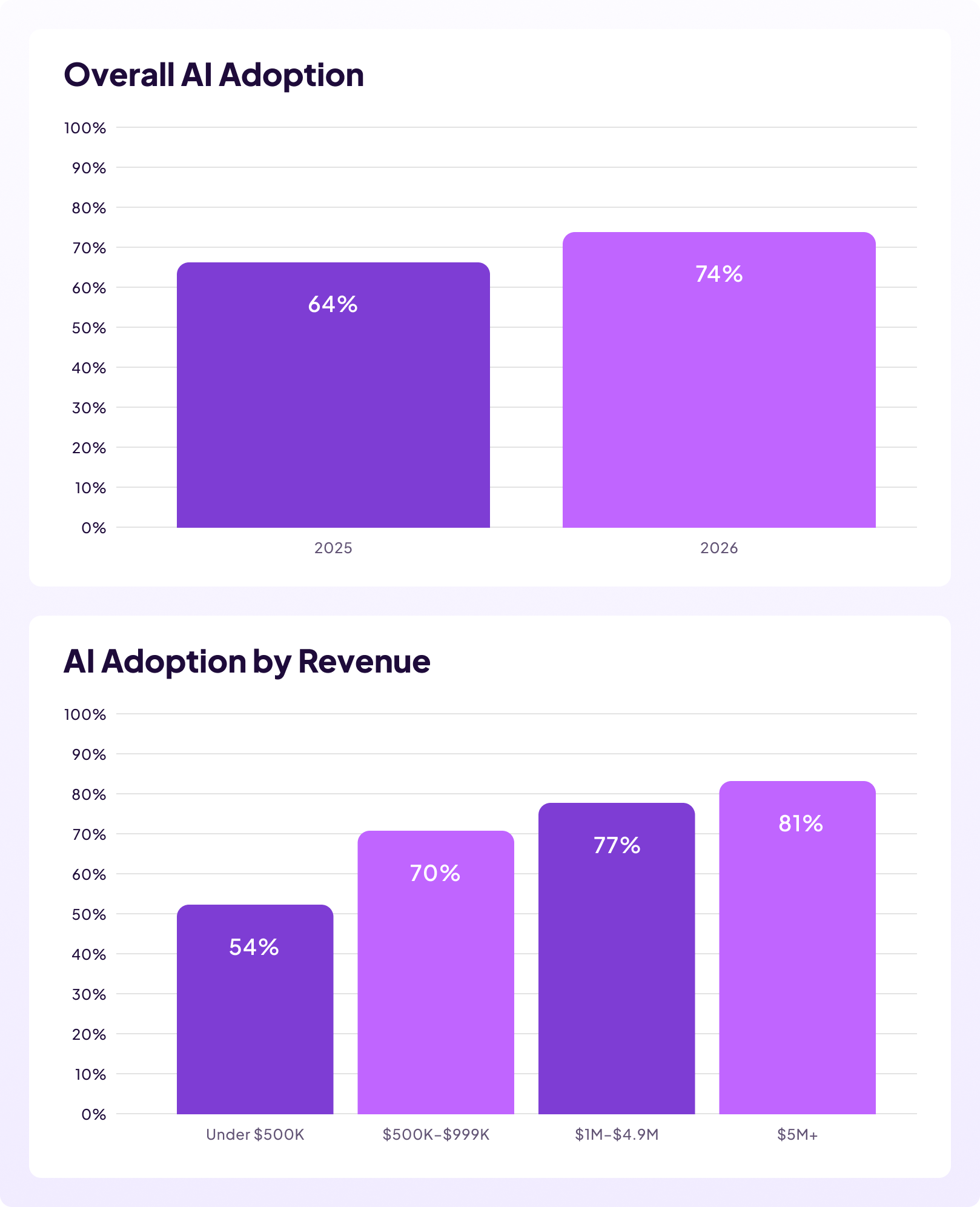
Source: Homebase, “2026 Main Street AI Gap Report”, 22 September 2026, a survey of 750 US small-business decision-makers. This is Homebase’s own survey.
“Just 54% of businesses under $500K in annual revenue are using AI, compared to 81% of businesses at $5M or more, a 27-point gap.”
Overall, 74% of the small businesses surveyed now use or pilot AI tools, up from 64% last year. The smallest businesses are the ones falling behind, so a few hours learning it now puts you ahead of most of your size.
Too early
Google’s Live Avatar turns its voice AI into a talking, lip-synced video person, which you can model on your own brand character. It’s live now, but only for large companies on Gemini Enterprise. Worth watching if you’d like a video face on your customer service one day. (blog.google)
🎬 One for the road
Over the weekend, my X feed got taken over by AI music videos. @anabology, who made the remix that went viral, calls the style “slopcore”: glossy music videos made almost entirely by AI and mostly about AI, like a fashion film crossed with a K-pop video, with lyrics full of AI in-jokes like “Feel the AGI.”
The surprising part is how they’re made. One person writes a prompt, an AI image tool makes the visuals, an AI music tool makes the song, and Claude stitches it all together overnight. One creator says he can’t code and made his first song this way.
It started with one post on 23 September. Two days later a remix passed 19 million views, and on 28 September Elon Musk shared it with “I really felt the AGI profoundly this time.” After that, everyone wanted to make their own.
If you want to try it yourself, download @anabology’s slopcore library here.
My takeaway. You’ll see a lot more of these, but the real story is how good AI video has become. A video that once needed a studio, a crew and a budget now takes one person and a night.
You don’t need a K-pop video. But it’s worth learning how to make short AI video that fits your own brand, like a product teaser, an ad or a how-to. The future is already here.